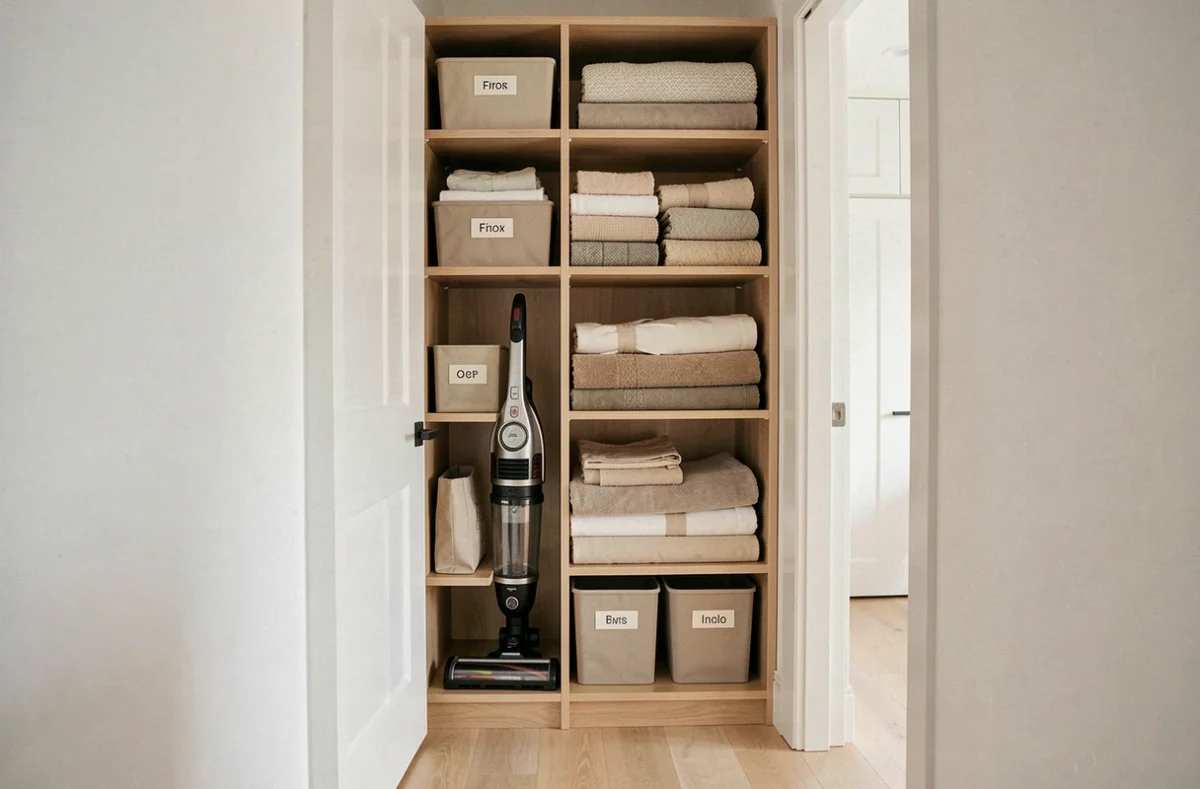
A vacuum cleaner balanced against the hallway wall, a cord lying around, a broom stuck between two coats: this scene resonates with many households. Storing a vacuum cleaner in a closet seems simple, but the shape of the device, its cord, or its charging station can quickly complicate things. The right approach is to adapt the closet to the vacuum cleaner, not the other way around.
Lithium-ion battery and closet ventilation: the overlooked safety point
Most storage guides focus on practicality. They overlook a technical parameter that concerns all cordless stick vacuums: the lithium-ion battery.
These batteries must be kept in a dry space, at a moderate temperature, and sufficiently ventilated. A closed closet without airflow prevents heat dissipation during charging. Over time, this can reduce the battery’s lifespan.
Have you ever noticed that your vacuum cleaner gets slightly warm during charging? That’s normal, but this heat needs to escape. Several precautions are necessary to find the right vacuum storage solutions while respecting this constraint.
- Leave a space of at least a few centimeters between the charging device and the walls of the closet, or drill discreet ventilation holes in the upper part of the door.
- Never store the vacuum cleaner while charging near flammable products (aerosols, solvents, soaked cloths). This accumulation of materials in a closed space increases the risk in case of failure.
- Watch for signs of a defective battery: swelling, abnormal heat, chemical smell, or unusual noise. In this case, immediately remove the device from the closet and stop charging.
This safety aspect does not concern traditional corded canister vacuums. However, it is central for cordless models that remain plugged into their station at all times.
Vacuum dimensions and closet layout: measure before buying a holder
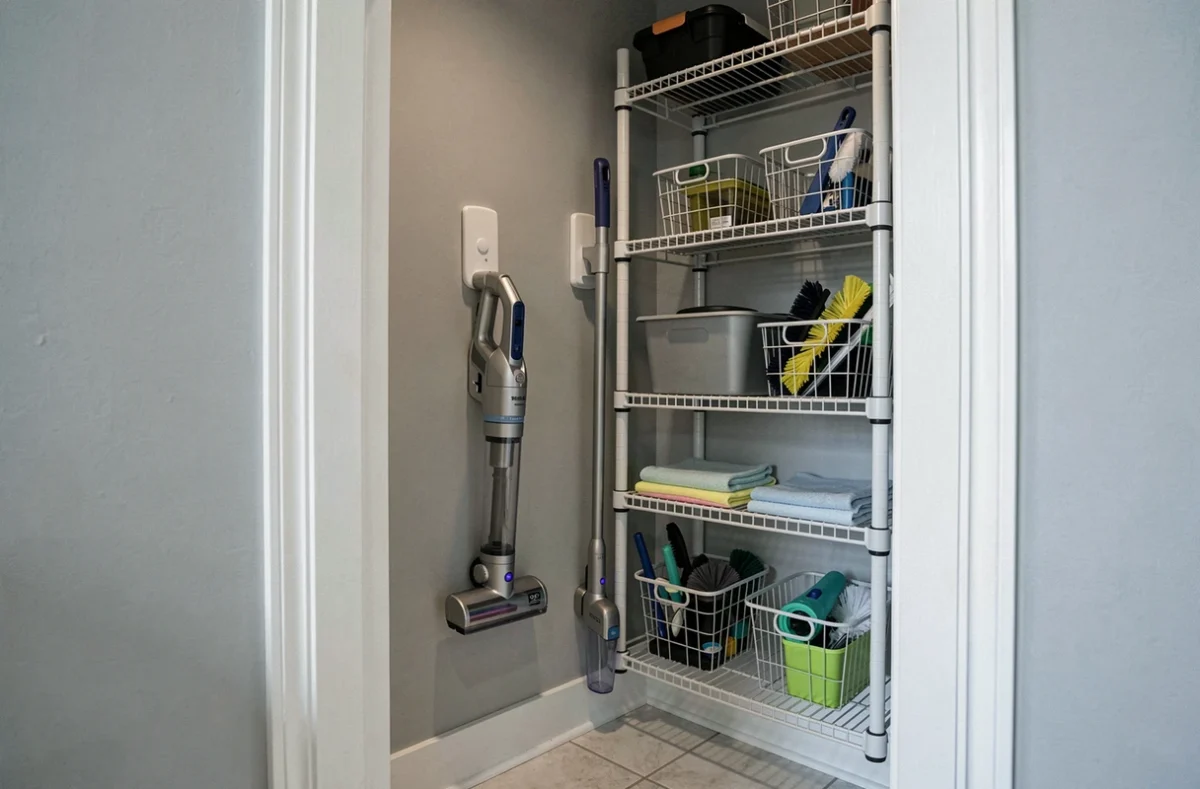
A stick vacuum often measures over a meter tall when placed on its station. A canister vacuum, on the other hand, is compact but bulky in width with its hose and accessories. Measuring the usable height and depth of the closet before any installation avoids unpleasant surprises.
For a stick vacuum, the wall mount provided by the manufacturer remains the most stable solution. It is fixed inside the closet, on the back wall or on one side. Keep in mind that the handle may sometimes extend above the holder: the closet door must be able to close without forcing.
Electrical outlet inside the closet
The charging station needs an outlet. In France, the NF C 15-100 standard governs the placement of outlets in homes. If your closet does not have an outlet, adding an electrical point by a professional is the safest solution.
Avoid extension cords that pass under the closet door. They wear out with repeated openings and create a weak point.
Canister vacuum: utilizing height
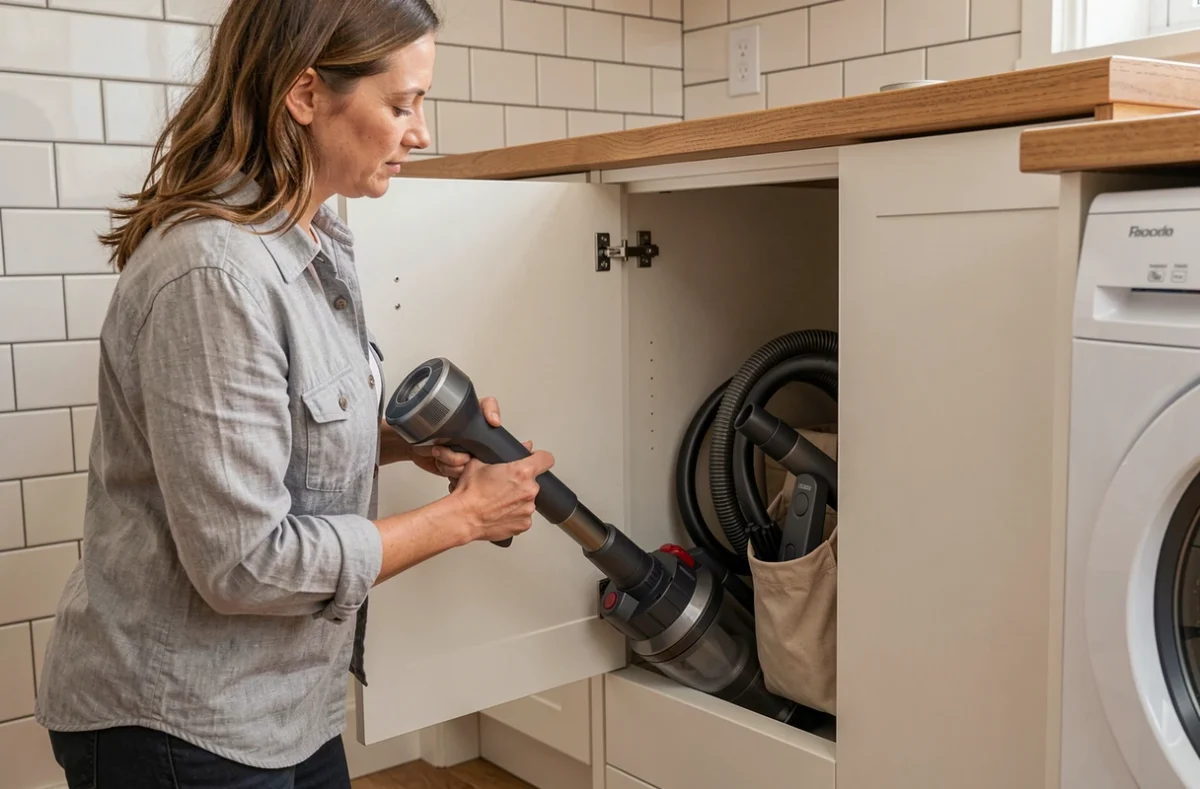
A hook fixed high allows you to suspend the hose and frees up floor space. The nozzles and brushes can be stored in a small bin attached to the inside door or on a low shelf. The goal is to be able to take out the vacuum in one motion, without untangling cords.
Organizing accessories and cords without losing space
The accessories that come with the vacuum cleaner (crevice tool, upholstery brush, textile nozzle) often end up in a separate drawer or in a loose bag. The result: they can’t be found when needed.
The most effective principle is to keep each accessory within reach, in the same place as the device. A few concrete solutions work well in a standard closet:
- A fabric pocket organizer, attached to the inside of the door, holds small nozzles without taking up space.
- An adhesive clip or spring tool holder, screwed onto the side wall, keeps the hose or additional handle in a vertical position.
- For cords, a wall-mounted reel or a simple S-hook prevents tangles. The neatly coiled cord frees up the floor space in the closet.
You don’t need a dedicated piece of furniture. A laundry or entry closet with a depth of about forty centimeters is sufficient, as long as you utilize the vertical walls.
Robot vacuum: a discreet station with its own constraints
Robot vacuums are stored differently. Their charging station takes up little height but requires clear space in front of it for the device to dock properly.
The station must remain accessible at all times, even if it is placed in an open closet or under a piece of furniture. If you close the door, the robot will not be able to return to recharge automatically after its cleaning cycle.
Some recent models include a station with an automatic emptying bin. These stations are taller and noisier during emptying. Place them in a room where the occasional noise is not a bother, such as a garage or laundry room.
A final often overlooked point: keeping the station’s cords flush against the wall prevents the robot from getting tangled in them during its passes. Most stations have an integrated reel under the base, but you need to remember to use it.
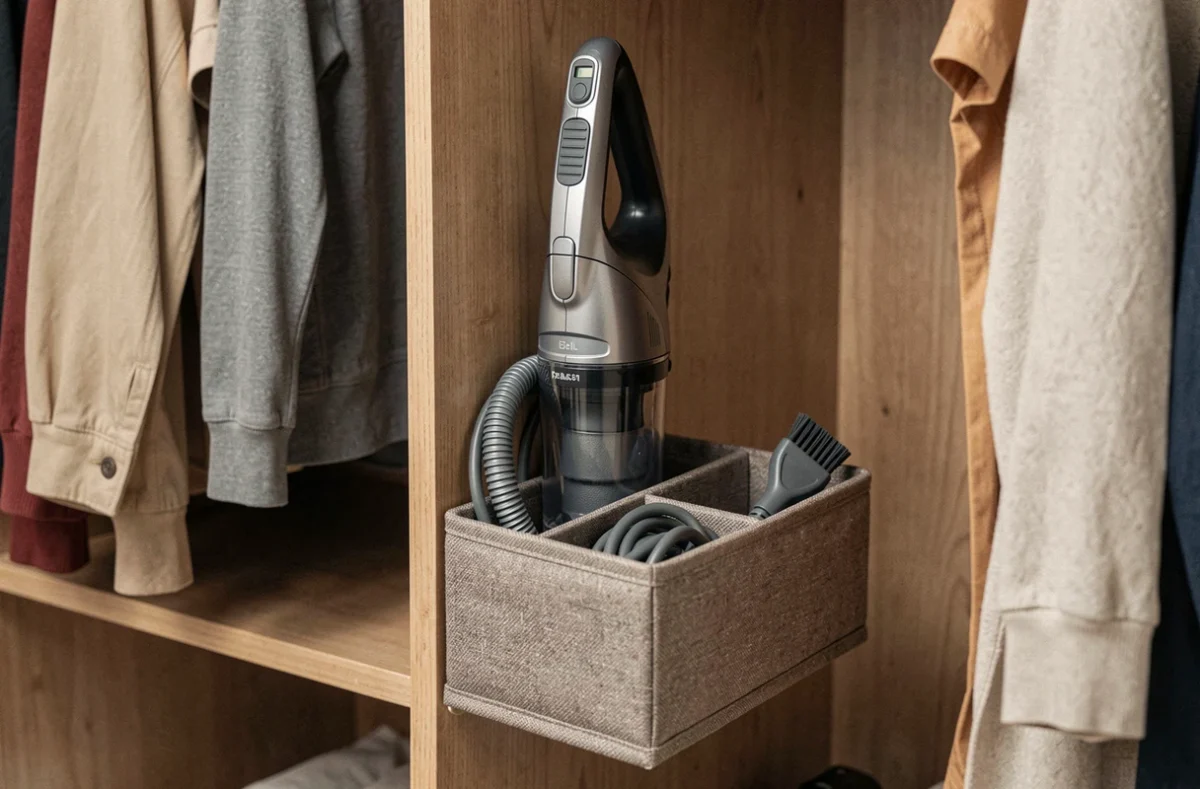
Storing a vacuum cleaner in a closet is not just about finding a free space. Ventilation for batteries, the presence of an outlet, the appropriate wall mount for the model, and the organization of accessories form a coherent whole. A well-thought-out closet for this specific use transforms a daily chore into a smooth gesture in just a few seconds.