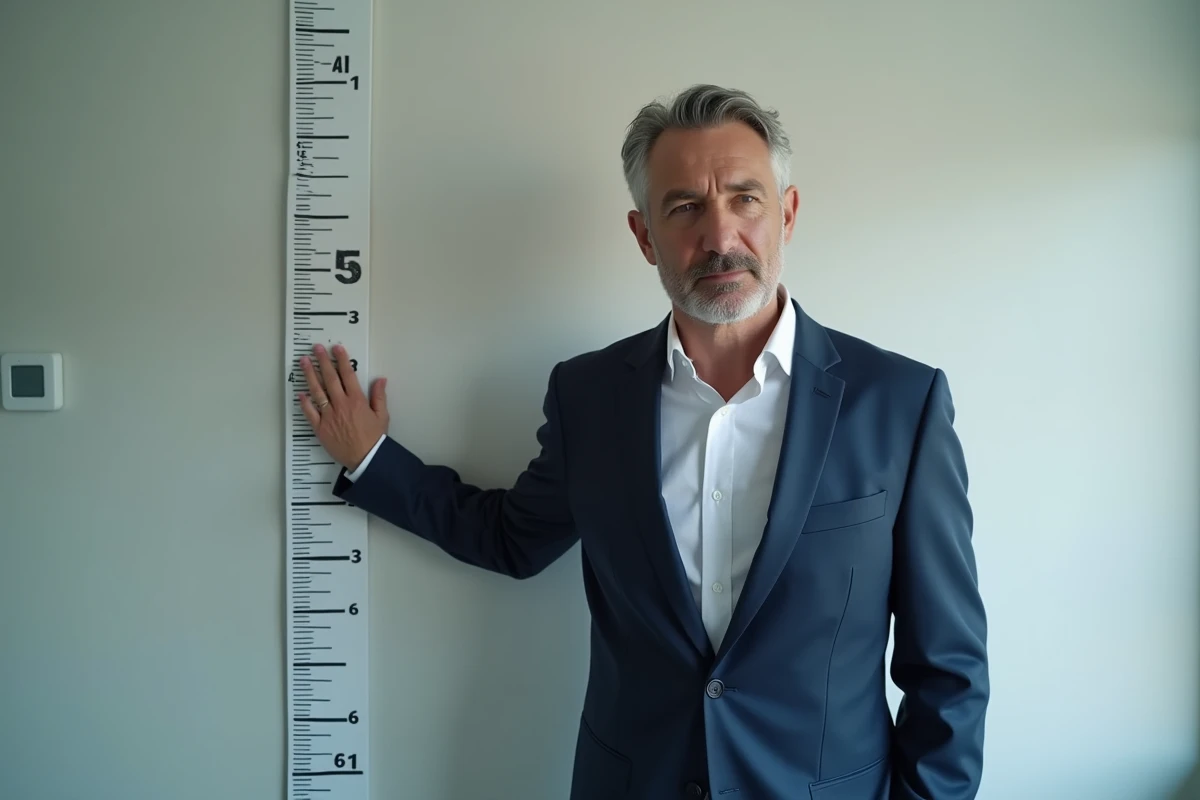
1.73 meters. This seemingly mundane figure has slipped into the media frenzy surrounding Éric Zemmour, fueling debates, mockery, and speculation. As it circulates, it sometimes reveals more about our era, and the place of personalities in the political arena, than about the man himself.
When the debate focuses on centimeters, Éric Zemmour’s personal journey quickly reminds us that surface appearances do not tell the whole story. His history is written on a whole different register: Algerian Jewish roots, born in Montreuil in 1958, a solid academic path up to Sciences Po, then rejected from the ENA. Despite this setback, he imposes himself in his own way, in the media, through writing and controversy.
Journalist, editorialist, essayist: so many hats for someone who, from Le Figaro to the Parisian sets, has built a presence. Slim silhouette, 1.73 meters and 65 kilos displayed, always controlled appearance: dark suit, tightened tie, salt-and-pepper hair. Behind the scenes and under the spotlight, “Le Z” shapes his image, refining it through clashes and televised debates.
Behind the public persona, private life constantly surfaces: Mylène Chichportich, Sarah Knafo, children Thibault, Hugo, and Clarisse. But it is the stage presence—voice, gestures, authority—that captures and divides, crystallizing attention more surely than any physical detail.
To stop at Éric Zemmour’s height is also to question the power of symbols in contemporary politics. Sometimes, it is less about the number than the image projected that weighs heavily. For more about Éric Zemmour’s height, the discussion continues even in social circles, relentlessly feeding the media machinery.
Éric Zemmour’s Journey and Personality: Beyond Simple Stature
Reducing Zemmour to a number or a caricature would be a dangerous shortcut. The obsession with immigration leaves its mark on his political engagement: he keeps hammering, especially during the 2022 presidential campaign, that France’s future hinges on this fault line. The national narrative stands as his banner, in a claimed lineage with the hardest right, even daring to challenge or openly provoke disagreement.
His economic axis remains equally sharp. Zemmour proposes massive liberalization, demands less state intervention, and elevates the entrepreneur to the status of a modern hero. For him, the administrative machine slows progress, while private energy revitalizes. Essentially, it is the dream of a country that would free itself from the burdens of the past.
His way of speaking and writing does not allow for lukewarmness. He embraces division, prefers intellectual confrontation and controversy, leading Reconquête! as the figurehead of a France anxious about dissolving but faithful to the memory of an ancient greatness. For Zemmour, every speech becomes strategy, every historical reference turns into a combat argument.
It is impossible to ignore the element of scandal. Lawsuits for incitement to racial hatred both generate criticism and notoriety, weaving a trajectory where media stature owes nothing to chance or mere physical presence.
What Are the Major Ideas Put Forward by Éric Zemmour and How Do They Structure His Discourse?
The architecture of Éric Zemmour’s thought rests on distinctly identifiable foundations. He places the fight against immigration at the center, arguing that it conditions both the unity and cultural survival of the country. To defend this thesis, he multiplies references to History, insisting on the border, a constant metaphor for a France to be preserved. This line appeals to the right, particularly the most radical electorate, accustomed to symbolic jousts and straightforward stances.
The economy follows an equally clear trajectory: freedom to undertake stands in direct opposition to a state deemed suffocating. Zemmour denounces the weight of bureaucracy, envisions a France resurrecting individual dynamism, a country revitalized by private initiative.
For him, the art of division becomes a tool. He embraces dividing, cutting, pushing the debate to the breaking point to solidify a compact base around him. “Reconquête!” thus establishes itself as the banner of a France that braces itself on its past markers while seeking to challenge the fear of direct debate.
Some events punctuate his style: striking declarations, assumed controversies. Each time, the strategy is enriched by a mix of rupture, media posture, and total absence of compromise. Nothing is left to chance in the pursuit of shock as much as media relay.

Zemmour’s Influence on French Society: An Analysis of Reactions and Debates Generated
The debate over Éric Zemmour’s height is less about the number and more about what it reveals. His media presence generates a continuous flow of comments, parodies, and disputes on social media.
To illustrate the variety of these reactions, here are some common examples:
- His appearance, sometimes likened to that of celebrities like Timothée Chalamet, or fictional characters, serves as a pretext for satire or irony.
- Jabs, sometimes coming from the political world itself, question Zemmour’s “symbolic stature,” implying how much physicality weighs in the assessment of a presidential profile.
The public sphere, for its part, dissects every physical detail of the polemicist:
- Attacks and support seize on the subject of appearance to nourish their respective arguments.
- This obsessive interest reveals, among some commentators, the survival of deeply rooted stereotypes, while others see it as the fragility of a collective notion of authority and legitimacy.
It goes without saying that from the cut of his suit to the way he walks, no detail of attire or behavior truly escapes analysis or polemical appropriation. Form invades everywhere, as political struggle also plays out at this level.
The rise of social media amplifies this phenomenon: the public perception of Éric Zemmour now extends far beyond the television sphere. Digital platforms amplify every comment, every shared image, to the point that the slightest pose or new publication sharpens, disrupts, or further freezes the collective portrait of the character.
- Self-promotion clashes with parodies, each publication stoking the fire of discussion or contestation.
- And this debate around the “real height” reflects everything society expects, or fears, from those it imagines governing: concern for appearance, the power of the symbol, the quest for political legitimacy remain ever-present.
So, do these famous centimeters become an issue or merely a pretext? The public space responds with tumult. From trivial details sometimes arise the most enduring divides: proof that everything in political life can become a matter of face-to-face encounters, labels, and images etched for a long time in collective memory.