
White vinegar’s acetic acid acts as a non-selective contact herbicide. On a lawn, this means it indiscriminately burns both weeds and grass. The distinction between “targeted herbicide” and “generalized phytotoxic” is the first piece of information to integrate before any application.
Acetic Acid and Grass: Mechanism of Phytotoxicity
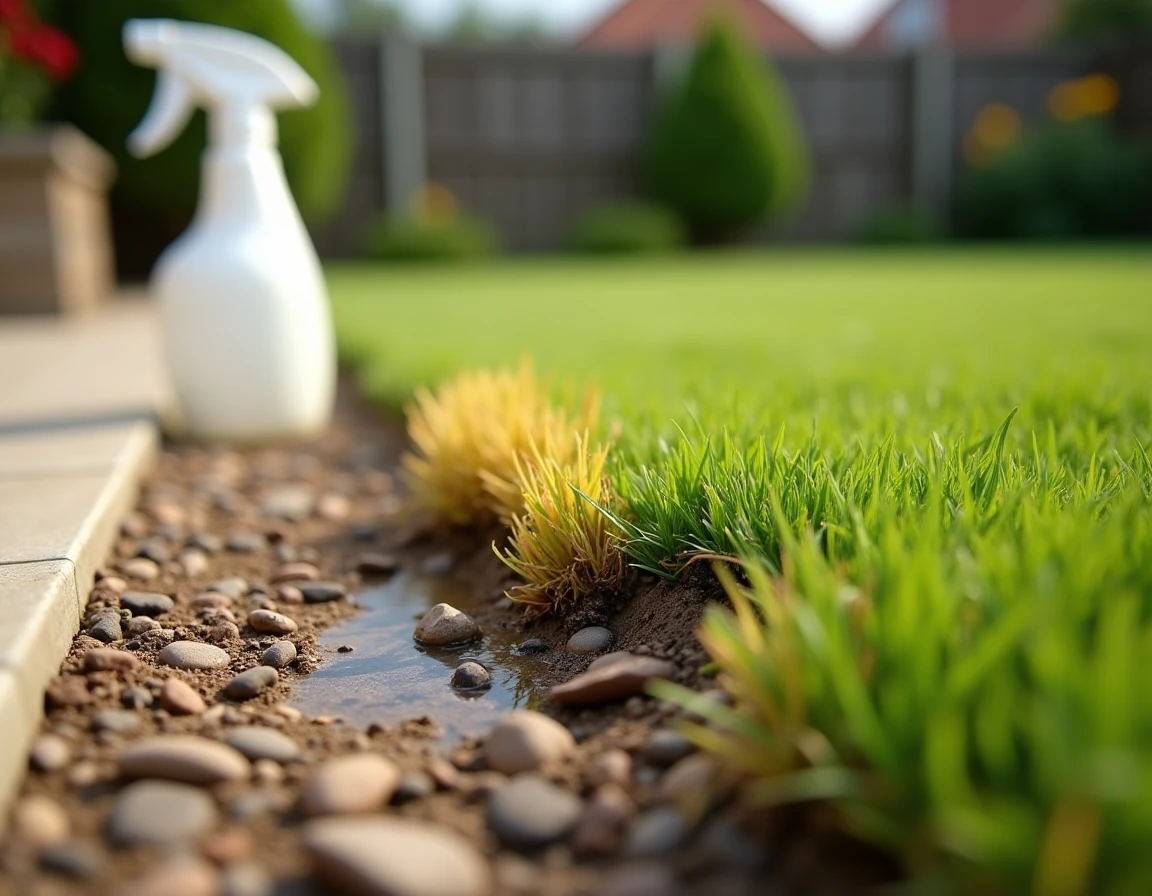
Acetic acid, even at the concentration of household white vinegar, destroys the leaf cuticle by cellular desiccation. The action remains strictly foliar: the product does not migrate to the root system.
On a lawn composed of ryegrass, fescue, or bluegrass, this foliar destruction causes rapid yellowing of the affected blades. Grasses with short stolons or weak tillering regenerate poorly after repeated acid burns.
We observe in the field that deep-rooted weeds (dandelion, plantain, bindweed) systematically regrow after vinegar treatment, as only the aerial part is affected. The lawn suffers the same foliar damage but loses density with each application, which opens up colonization niches for mosses and acidophilic dicotyledons.
Research from INRAE on the ecological management of grassy areas confirms that acidic weeding deteriorates the structure of the grass mat over the seasons.
Before using vinegar on the lawn, one must accept a paradox: the product temporarily eliminates visible weeds, but it weakens the grass that should be competing with them.
Soil Acidification and Impact on Biological Life

The effect of vinegar is not limited to the leaves. During spraying, a fraction of the product reaches the soil. On a light, sandy, or poorly buffered substrate, this fraction is sufficient to lower the pH locally.
EFSA, in its review of acetic acid-based substances used in biocontrol, reports that repeated applications lead to increased mortality of earthworms and a decrease in microbial activity in the top few centimeters of soil. This sensitivity is considered significant even though acetic acid degrades quickly.
In practical terms, soil depleted of earthworm fauna loses its natural decompaction capacity. The lawn receives less root aeration, organic matter decomposes more slowly, and thatch establishes itself. It’s a vicious cycle: vinegar eliminates the organisms that keep the lawn healthy.
Buffered Soils vs. Acidic Soils
On a calcareous soil with a pH above 7, the buffering capacity partially neutralizes acetic acid. The biological impact is less pronounced in the short term. On already acidic soil (pH below 6), each application worsens the imbalance and promotes moss at the expense of grasses.
We recommend knowing your soil’s pH before any attempts. A simple measurement kit from a gardening store is sufficient. If the result indicates acidic soil, vinegar is counterproductive, regardless of the dose.
White Vinegar as a Herbicide: Regulatory Framework in France
White vinegar has no marketing authorization (MA) as a herbicide. Under French law, any product used to destroy plants falls into the category of plant protection products and must be approved by ANSES.
The use of white vinegar as a herbicide on impermeable surfaces (sidewalks, driveways, patios) is explicitly prohibited. The risk of runoff into stormwater systems and aquatic environments motivates this prohibition.
On lawns, the legal situation remains unclear for many individuals, but the principle is the same: a product without MA used to destroy plants constitutes an infringement. The “natural” character of acetic acid does not change this.
Effective Alternative Practices for Lawns
Rather than resorting to vinegar, several approaches preserve lawn density while limiting weeds.
- Targeted overseeding involves replanting sparse areas with a mix suited to the soil and exposure. A dense lawn is the best defense against weeds, as it occupies the available root and light space.
- High mowing (7 to 8 cm in summer) deprives weed seedlings of light at the soil level. Grass species tolerate this height well and develop a deeper root system.
- Manual mechanical weeding (weeding knife, gouge) remains the most precise method for extracting dandelions or plantains without damaging neighboring grass. On a moderately sized lawn, the time invested is comparable to that of spraying followed by necessary touch-ups.
- Applying lime or calcium amendment corrects a low pH and naturally reduces moss pressure, without resorting to a contact herbicide.
These methods require consistency, but they strengthen the lawn instead of weakening it. Vinegar has the opposite effect: each application weakens the lawn and prepares the ground for new unwanted plants.
Vinegar and Salt Mixture: An Increased Risk
Adding coarse salt to vinegar, often presented as a “grandmother’s recipe,” multiplies the damage. Salt persists in the soil much longer than acetic acid. It causes salinization that prevents any grass regrowth for several months, sometimes several seasons on clay soil. We strongly advise against this mixture on any surface intended to remain grassy.
White vinegar remains an effective household product for indoor cleaning. On a lawn, its benefit/risk ratio is unfavorable: effectiveness limited to aerial parts, collateral damage to the grass and soil life, and lack of legal approval. It is better to invest the same time in mechanical and cultural maintenance that sustainably strengthens lawn density.