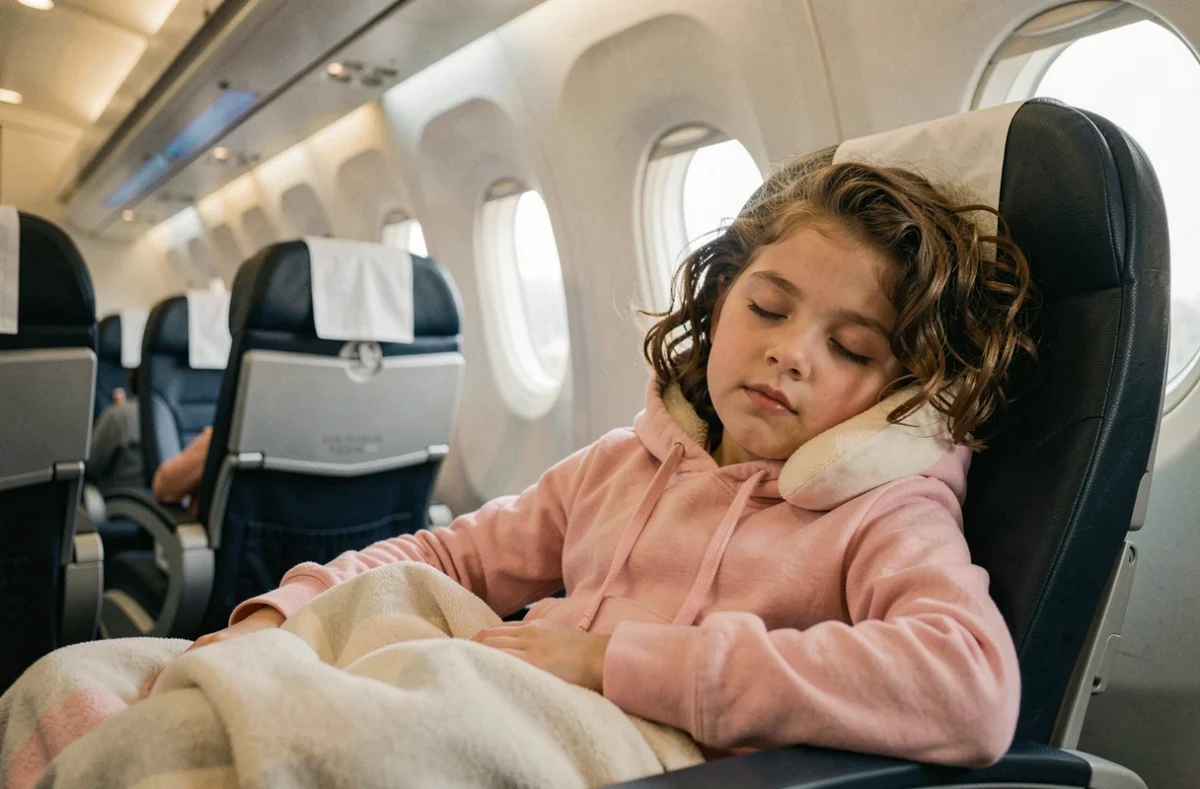
Sleep in the cabin depends less on the child than on the conditions you create: flight time, seat type, light management and preparation for jet lag. The American Academy of Pediatrics strongly advises against using diphenhydramine or dimenhydrinate to make a child sleep while travelling. It’s better to focus on practical arrangements and accept that a child who is awake but calm is a perfectly manageable outcome.
Car seats on planes: regulations and their impact on sleep
For a child under 2, the FAA recommends booking an individual seat with an approved child restraint system rather than holding the child on your lap. In unexpected turbulence, an adult cannot safely hold on to an infant. As well as providing greater safety, a car seat recreates a familiar environment that can make it easier for a child to fall asleep.
The catch is that your usual car seat may not be accepted on board. The EASA says that each airline decides which devices are permitted. Some airlines only accept forward-facing seats or set a maximum width to ensure the seat fits between the armrests. Check these requirements with the airline before booking to avoid an unpleasant surprise at boarding, especially if you’re counting on the seat to help your children sleep on the plane during a long-haul flight.
A car seat certified for aviation use will generally carry the wording “approved for aircraft use” or its European equivalent. Without this label, the airline may refuse to let you install it.
Jet lag in children: adjust their body clock before the flight
The AAP recommends gradually shifting your child’s sleep schedule in the two or three days before departure. In practice, move bedtime forward or back by 20 to 30 minutes each day, depending on the direction of travel. This adjustment to the body clock is intended not just to help your child sleep on board, but above all to help them recover once you reach your destination.
After arrival, getting daylight in the morning helps reset the circadian rhythm. Young children adapt faster than adults, as long as you don’t force artificial naps that delay the adjustment.
Choose a flight time that fits your child’s routine
A night flight that coincides with your child’s usual bedtime increases the chances of them falling asleep naturally. For daytime flights, choosing a time that overlaps with their nap is still the most reliable strategy. On a medium-haul flight, an early-afternoon departure often works better than an early-morning one that means waking your child too soon.
A tired child isn’t necessarily a child who will fall asleep easily. Overstimulation from exhaustion can have the opposite effect. Keeping tiredness at a moderate level, rather than overdoing it, tends to work better than a day packed with activities before boarding.
A realistic flight strategy: when your child doesn’t sleep
Sleep doesn’t have to be the goal on every flight. A child who stays calm and occupied for several hours already makes for a successful journey. Building your entire strategy around getting them to sleep can frustrate parents and put pressure on the child, who will pick up on it.
Cabin comfort without obsessing over sleep
A few practical choices can make all the difference, whether your child sleeps or not:
- A travel pillow suited to their size, placed against the window or a parent, provides a comfortable semi-reclined position even when they’re awake
- Loose-fitting clothes, such as pyjamas or jogging bottoms, and thick socks: cabin temperatures can drop noticeably on night flights
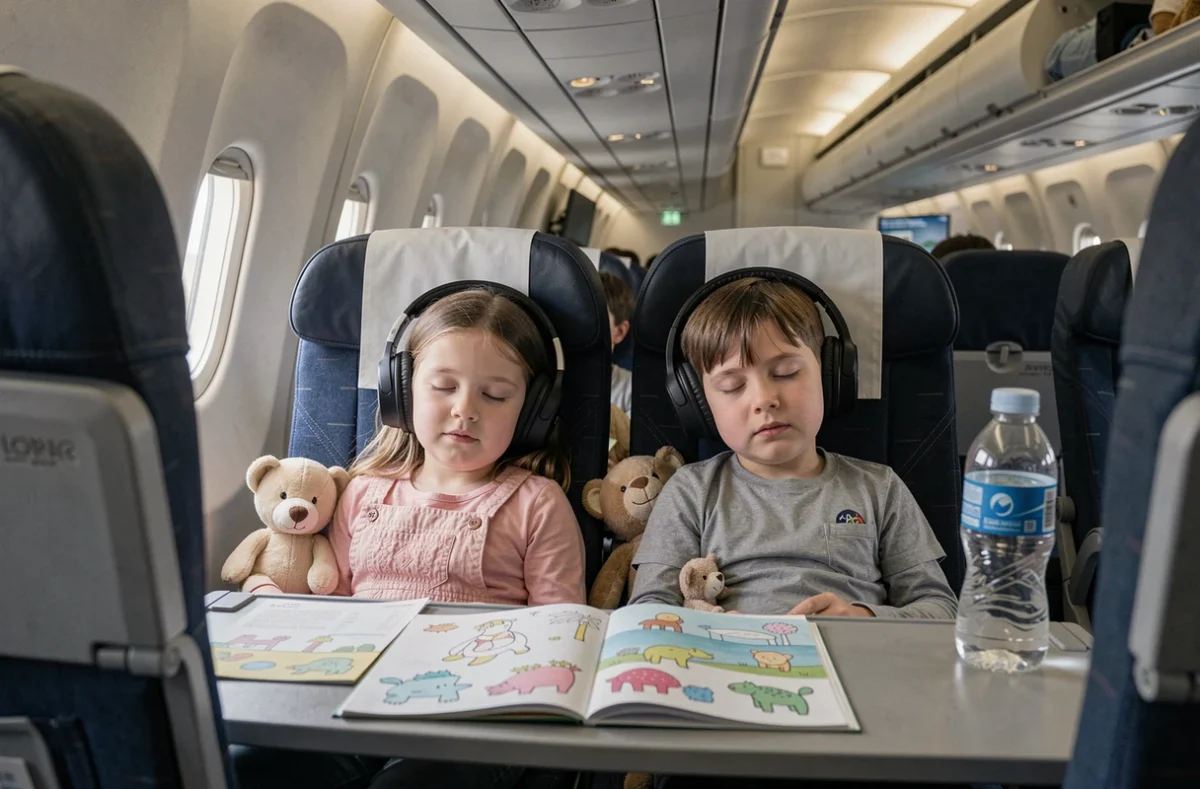
- Children’s noise-cancelling headphones (in a suitable size, generally from around age 2) reduce the steady background noise from the engines, which can be loud over a long-haul flight
- A familiar blanket from home rather than the airline’s, for a reassuring scent
Quiet activities to keep things calm
Screens can help, but their blue light disrupts melatonin production. If sleep is still a secondary goal, limit screen time in the hour before you’d like your child to rest. Quiet activity books, reusable stickers or hands-on sensory toys can hold their attention without the light stimulation.
For children over 3, an audiobook with headphones offers a good compromise: a story can help them relax without a screen. Pack three or four short activities rather than one long one, as attention spans tend to shrink with fatigue.
Flying safely with a child: often-overlooked points
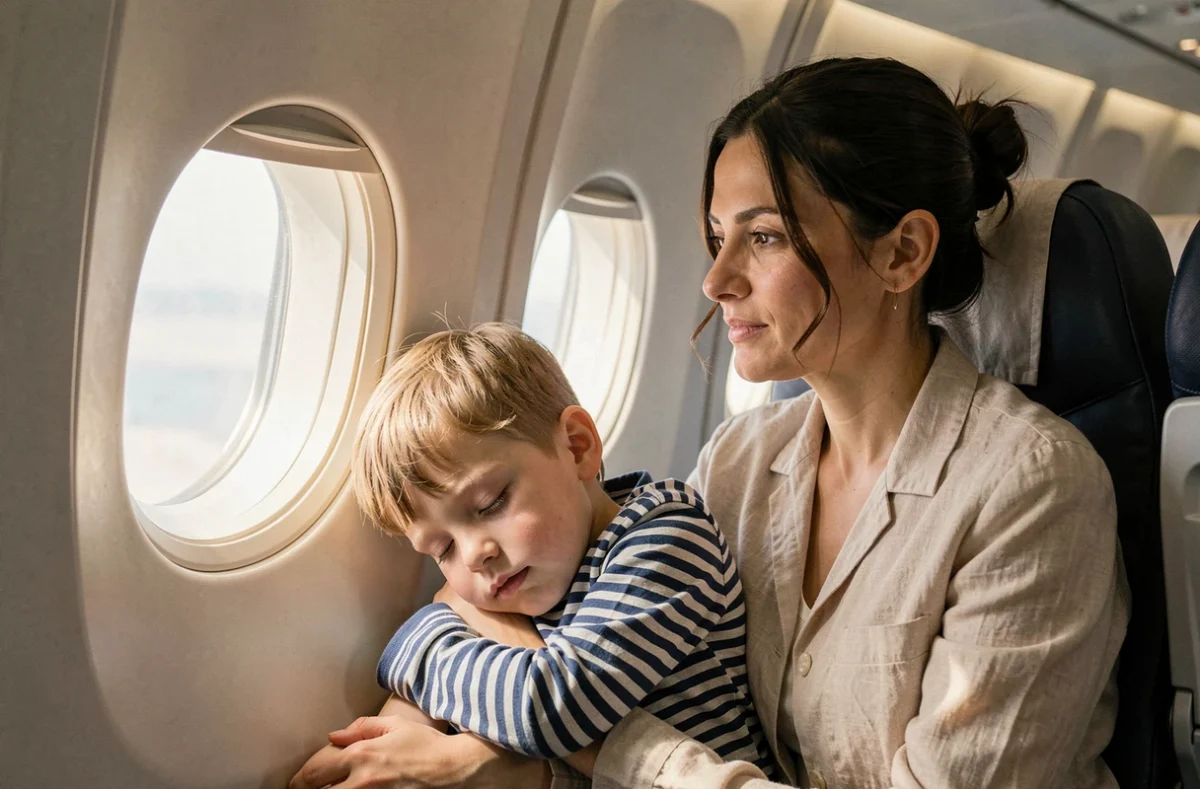
Sleep often distracts from the question of safety. A child asleep on your lap is not secured. In severe turbulence, they could be thrown from your arms. The FAA’s recommendation is clear: every passenger, regardless of age, is better protected in their own seat with a restraint system.
The bassinet offered by some airlines is reserved for infants below a certain height and weight, which vary by airline. A bassinet does not provide protection during turbulence: when the seat belt sign comes on, you must take your child onto your lap or place them in their car seat.
- Keep the seat belt fastened around a child sleeping in their seat, even when the sign is off
- Don’t place a thick blanket under the belt, as this reduces its effectiveness as a restraint
- Check that the car seat harness is still properly adjusted after your child falls asleep, as children often slip down while sleeping
A smooth flight with children depends on planning the practical details in advance, not hoping everyone will sleep. The right seat, a flight time that fits their body clock and a few quiet activities cover most situations. Accepting that an awake but relaxed child is a good outcome changes how you approach every journey.