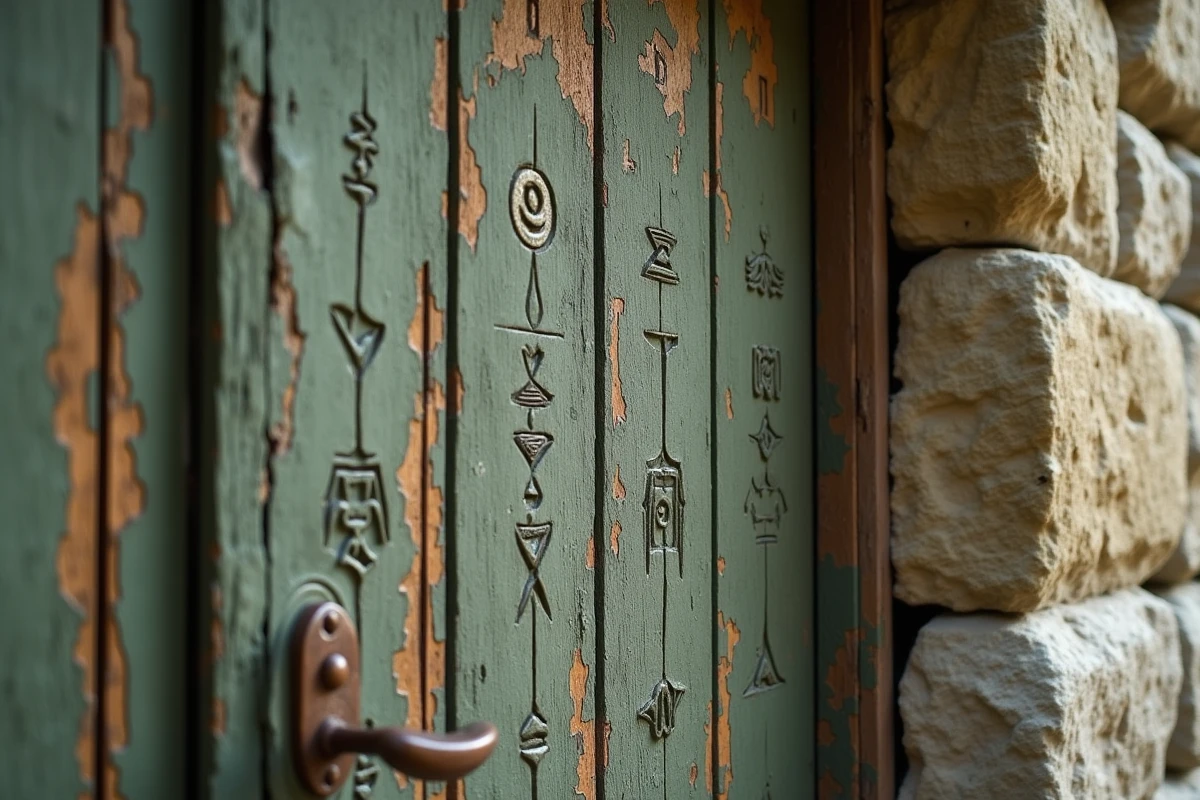
A chalk mark on the garage wall, a cross drawn with a marker near the mailbox, a small round sticker stuck on the gate: these marks are discovered one morning without knowing how long they have been there. The reflex is to search for their meaning online, and one quickly stumbles upon lists attributed to “Gypsy signs.”
The subject deserves a more rigorous treatment because the reality of these markings is quite different from what viral publications suggest.
Markings on houses: what law enforcement really observes
When spotting a suspicious symbol on one’s facade, the first practical question is whether it is a genuine burglar marking or an innocuous graffiti. Police services and security companies documenting these marks (Verisure, ABUS, Local Police Montgomery in Belgium) arrive at the same conclusion: there is no universal dictionary of burglary signs.
The markings observed are described as variable, opportunistic, and non-standardized. A diamond shape may mean “empty house” in one neighborhood and have no meaning a few kilometers away. Burglars adapt their codes to their own network, sometimes even to a single operation.
To better understand the symbols and Gypsy signs in their real context, it is beneficial to distinguish what pertains to criminal marking from what pertains to culture or simple vandalism.
Feedback varies on this point, but several police sources agree on a concrete recommendation: photograph the mark, clean it immediately, and report its presence to the local police station or gendarmerie. Leaving the sign in place potentially confirms to the perpetrators that no one is watching the house.

Burglar signs: the most documented symbols and their interpretation
Even though no code is fixed, certain shapes regularly appear in the documentation of security professionals. Here they are grouped by their supposed function.
Symbols related to the level of home protection
- A circle or solid round shape would indicate an easy target, without an alarm or dog. This is the marking most frequently cited by police sources.
- A triangle or an inverted “V” shape would indicate the presence of an alarm system, discouraging a quick attempt.
- Parallel lines or horizontal bars are sometimes associated with the presence of a guard dog or a vigilant neighbor.
Symbols related to the habits of the residents
- A simple cross could indicate that the occupants are regularly absent, for example, during working hours.
- A “D” or a semicircle is sometimes interpreted as “woman alone at home” or “elderly person,” signaling less resistance.
- Isolated letters (N, M, AM) would refer to time slots: night, morning, afternoon.
It is reiterated: these interpretations circulate widely, but no official source guarantees their universality. Burglars do not consult a common manual. Viral lists on social media freeze an “alphabet” that, in practice, remains fluid.
Why attributing to “Gypsies” poses a concrete problem
The term “Gypsy” is an exonym, meaning a name given from the outside to a group. European institutions, notably the Council of Europe, prefer more precise designations: Roma, Manouches, Sinti, or travelers depending on the geographical and cultural context.
Systematically attributing these markings to an entire community creates two practical problems. The first is an analytical error: by focusing on one group, one overlooks the fact that these marking techniques are used by all types of criminal networks, regardless of ethnic ties. The second is legal: spreading collective accusations may fall under defamation or hate incitement laws.
The viral content circulating on Facebook or in neighborhood groups perpetuates this confusion. Some of these “symbol guides” are even denounced as false by law enforcement themselves, who remind that the majority of markings photographed and shared online are graffiti unrelated to home marking.

Protecting your home after finding a suspicious sign
Rather than seeking the exact meaning of a symbol (often a futile exercise), it is better to react methodically.
Erasing the marking as soon as it is discovered is the first action. Soapy water for chalk, appropriate solvent for marker, scraper for a sticker. The longer the sign remains visible, the more it fulfills its signaling function.
Next, check the usual access points: front door lock, ground floor windows, garden gate, garage access. A burglar who has taken the time to mark a house has also identified its physical weaknesses.
Informing direct neighbors has a measurable deterrent effect. An attentive neighborhood network (even informal, without a dedicated app) makes the area less attractive for discreet marking. The gendarmerie also offers the “Operation Tranquility Vacances” program to report a prolonged absence and benefit from patrols.
On the equipment side, a visible alarm from the street changes the risk-benefit calculation for a burglar. There is no need for the most sophisticated system: a well-placed alarm sign and a fake (or real) camera at the entrance are often enough to change targets.
The issue of symbols on houses will continue to generate worried shares on social media. The best protection remains a quick reaction (erasure, reporting, checking access) rather than decoding an alphabet that, in practice, has never been standardized.